The buyer and workflow
Lifecycle marketers at small ecommerce brands
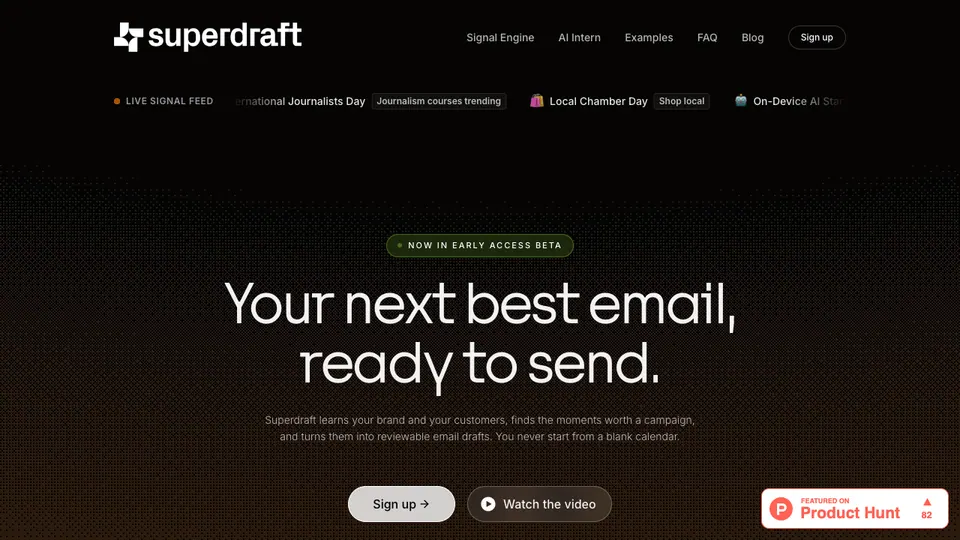
Superdraft presents a workflow that matches brand-relevant events with editable email ideas. The product observation is the signal-to-draft workflow; demand for a narrower offering still needs testing.
What the evidence establishes
Figures may be historical. Monthly sales and one-time purchases are not recurring MRR. Cross-check the original source before relying on a figure.
Revenue, paid customer count, conversion lift and demand for our category-specific hypothesis are unverified.
- Official product workflow
Brand-relevant campaign signals and drafts that a team can review, edit and export. Checked 2026-10-21.
- Adjacent platform pricing
Pricing should be checked for the intended contact volume, channel and billing configuration. Checked 2026-10-21.
An opening to investigate
A campaign briefing desk for one product category, with the event, reasoning and draft shown together.
A specific type of brand misses useful campaign moments and would prefer a focused briefing over its current planning process. Brands may already solve this adequately.
Check existing alternatives
Superdraft
Brand signals and reviewable email drafts. A current public price was not verified.
Klaviyo
An adjacent email marketing platform with contact- and channel-dependent pricing. Ask whether the existing campaign tools already cover the job.
Price a bounded manual campaign-brief pilot with the marketer after learning their planning cost. Do not treat a campaign platform subscription as spending available to a new add-on.
A focused first version
- Let a marketer enter a brand, product category and approved seasonal events.
- Prepare three campaign briefs with a source, suggested angle and editable draft.
- Capture an approve, reject or revise decision and export plain text.
Leave out of the first version
No email sending, audience scraping, deliverability platform, sales attribution or unattended brand publishing.
Reach the first five buyers
Independent lifecycle marketers and specialist ecommerce operators who already publish campaign breakdowns.
Find five marketers serving the same product category. Ask each to walk through last week’s campaign planning and show a missed or rejected idea. Offer three briefs based only on information they authorize you to use.
Your 48-hour test
In 48 hours, interview five marketers and manually produce three briefs for two consenting brands. Track which drafts are used, how much editing is needed and the time saved against their usual approach.
Continue if
Continue if two marketers use a brief in a real planning decision and one commits to a paid second batch with a defined delivery date.
Pause if
Pause if the existing calendar and email tools are sufficient, the ideas are generic, or checking the signals costs more time than it saves.
A brief for your coding assistant
Use this only after the buyer test. Review access, privacy and product scope before building.
Create an approval inbox for campaign briefs in one ecommerce category. Each brief needs a source URL, observed date, brand fit explanation, editable copy and decision log. Export text only. Mark speculative events, require human approval and do not connect a sending provider in the first version.
Something changed? Send a correction with a source.